Sometimes I wonder if I am the lab rat. I'm involved in a couple of federal research projects where change is the subject of the day. We know that there are problems with secondary education today. The focus in these projects is to facilitate positive change in student achievement. Let's follow this through, though....
In order to change student achievement, we must focus on those who interact with the kids. In my case, we are talking about middle and high schools for the most part. The focus of our work is on content literacy and in the encouragement of high levels of thinking and problem solving in secondary classrooms. We focus on engagement of students through keeping them sufficiently challenged with lots of feedback. This is a tall order in many classrooms today. The range of abilitites among students is huge. It is not an easy assignment for a teacher - especially in urban classrooms where academic diversity is the norm.
My point is that while our focus definitely is on changing outcomes for students, we must focus on helping the teachers change and adjust. They are often stressed and feel overwhelmed. Which brings me back to the title for today's post - Lab Rat. Sometimes I wonder if I'm not the lab rat after all! I recently attended a meeting where we were given our assignments for this school year. There were several new data collection tools and additional expectations were given. I reacted because I was under stress. I must also remember to adapt to change. My reaction was typical when it comes to feeling overwhelmed. I need to keep this feeling at the forefront of my work this year. I am sure this is what teachers feel everyday because we are asking them to step out of their comfort zone and do something that they don't quite understand yet. We are asking them to trust us and live with ambiguity. I must do the same thing.
Sunday, September 13, 2009

Saturday, June 27, 2009
Moved to Speak
Several years (over twenty now) I was caught up in the Community Building movement. I was a great fan of Dr. Scott Peck, the psychiatrist and author of The Road Less Traveled. I read every book he wrote, and I felt like I learned a lot from him. In some ways, I considered him a mentor from afar. In later books, including The Different Drum, Dr. Peck wrote about community, and how our world is in such desperate need of civility. I longed for the feeling of community, so I attended a Commuity Building Workshop at a retreat facility sponsored by The Foundation for Community Encouragement. Little did I know that I was on my path of partnership at that time.
One of the norms we followed in the community building circle was called Moved to Speak (mvd2spk). The idea being that there are so many words and voices when groups are together. People talk at the same time; often several conversations are going on within the same group. Who can really listen and pay attention? And that is the crux of it ... people talk, but no one listens. People tend to talk without thinking. There is so much "noise" that taking it all in can be a challenge. I love the idea of being "moved to speak." Why say something just to fill up the airwaves?
Meeting everyone's needs in a group can be tricky. This past week I led a group of twelve professionals in an institute which focused on working with adults. We all had lots of ideas and much to say. Early on, however, when we talked about our norms, someone asked that we honor the "2 Before Me" Rule. This rule is similar. This young lady said that she tends to talk a lot, and that remembering this rule helped her to pay attention to what others' have to say. It is very simple - let two other people talk before you say something. I then shared my thoughts about being moved to speak.
I think blogs and all the various types of social communicating allows us to express our voices. I hope that you may be moved to speak. What are your thoughts and ideas about helping adults working in groups to talk less and listen more? We would all be better for it, if we did more listening and less talking. I think that authentic caring and real listening are the foundations of building community and partnership with others.

One of the norms we followed in the community building circle was called Moved to Speak (mvd2spk). The idea being that there are so many words and voices when groups are together. People talk at the same time; often several conversations are going on within the same group. Who can really listen and pay attention? And that is the crux of it ... people talk, but no one listens. People tend to talk without thinking. There is so much "noise" that taking it all in can be a challenge. I love the idea of being "moved to speak." Why say something just to fill up the airwaves?
Meeting everyone's needs in a group can be tricky. This past week I led a group of twelve professionals in an institute which focused on working with adults. We all had lots of ideas and much to say. Early on, however, when we talked about our norms, someone asked that we honor the "2 Before Me" Rule. This rule is similar. This young lady said that she tends to talk a lot, and that remembering this rule helped her to pay attention to what others' have to say. It is very simple - let two other people talk before you say something. I then shared my thoughts about being moved to speak.
I think blogs and all the various types of social communicating allows us to express our voices. I hope that you may be moved to speak. What are your thoughts and ideas about helping adults working in groups to talk less and listen more? We would all be better for it, if we did more listening and less talking. I think that authentic caring and real listening are the foundations of building community and partnership with others.

"In and through community lie the salvation of the world."
M. Scott Peck, Introduction, The Different Drum
Tuesday, May 19, 2009
Where do bad decisions come from?
Honestly, I just can't figure it out. Where do bad decisions come from? How are really critical decisions made? I know that generally there are reasons why people act in the ways that they do. I have been heartsick this week because of a situation regarding (what in my view) was a terrible decision.
School change is such a complex process. I'm not sure how how many educated people actually understand this process. I am in the midst of it (and I have been for a number of years), and I certainly don't understand all of the factors. It is such a complex process. However, I do know that leadership is the critical variable. I'm working in a very difficult school located in a very difficult district located in probably one of the most economically disadvantaged city in the country. The school is only difficult because of resources and situation. The staff of this school is amazing - from the bottom up. I have worked with one of the finest high school principals that I've ever met for the past year and a half. She has been accessible, supportive, and extremely well liked by her staff. She knows how to make things happen in a day and time when that is not an easy skill. She keeps the staff motivated to succeed and focused on the students. She maintains an orderly climate in a challenged city. She provides programs and activities for students so that they have something positive to focus on.
Over the weekend this principal who I admire and respect deeply, learned that she was fired. This district where she has worked faithfully and with integrity simply threw her to the curb. After 25 years of teaching English and over 10 years as a principal in a popular high school, her contract was unceremoniously "non-renewed." I guess this is the nice terminology for fired. I am angry, hurt, puzzled, and heartsick. I've only worked with this woman for a year and a half and I feel this way. I can only imagine how others who have known her for years feel. I'm still stunned. I've written to the powers that be and the city newspaper. A friend of mine this morning told me to write to President Obama and congress. I'm thinking about it. I just might. I am so incensed with the unfairness and stupidity of this decision. In an age when we need the best people leading our schools, we get the best ones thrown out. To think that one person can change the achievement level of a school makes no sense. Improved achievement is going to take change and hard work from all constituents - teachers, students, administrators, parents, and the community. Until we all work together and stop the blaming, it simply will not happen.
School change is such a complex process. I'm not sure how how many educated people actually understand this process. I am in the midst of it (and I have been for a number of years), and I certainly don't understand all of the factors. It is such a complex process. However, I do know that leadership is the critical variable. I'm working in a very difficult school located in a very difficult district located in probably one of the most economically disadvantaged city in the country. The school is only difficult because of resources and situation. The staff of this school is amazing - from the bottom up. I have worked with one of the finest high school principals that I've ever met for the past year and a half. She has been accessible, supportive, and extremely well liked by her staff. She knows how to make things happen in a day and time when that is not an easy skill. She keeps the staff motivated to succeed and focused on the students. She maintains an orderly climate in a challenged city. She provides programs and activities for students so that they have something positive to focus on.
Over the weekend this principal who I admire and respect deeply, learned that she was fired. This district where she has worked faithfully and with integrity simply threw her to the curb. After 25 years of teaching English and over 10 years as a principal in a popular high school, her contract was unceremoniously "non-renewed." I guess this is the nice terminology for fired. I am angry, hurt, puzzled, and heartsick. I've only worked with this woman for a year and a half and I feel this way. I can only imagine how others who have known her for years feel. I'm still stunned. I've written to the powers that be and the city newspaper. A friend of mine this morning told me to write to President Obama and congress. I'm thinking about it. I just might. I am so incensed with the unfairness and stupidity of this decision. In an age when we need the best people leading our schools, we get the best ones thrown out. To think that one person can change the achievement level of a school makes no sense. Improved achievement is going to take change and hard work from all constituents - teachers, students, administrators, parents, and the community. Until we all work together and stop the blaming, it simply will not happen.
Wednesday, March 18, 2009
The Need for More "Tempered Radicals" in our Schools
Debra Myerson, Professor of Education at Stanford, and author of the acclaimed book "Tempered Radicals: How Everyday Leaders Inspire Changes at Work" is a very validating work for me. It provides hope and a sense of fulfillment as well. I often tell teachers to NOT underestimate their ability to influence others and make change. So often, I hear teachers' voices that sound tired and, to be honest, a bit hardened. So much of being a good teacher well into the latter years of teaching is about having some control over what happens in the environment. Having control over what happens in the classroom is easy, but what is more important is exerting a positive influence on those around us. Teachers have a huge influence on the future of the country, and it's well-being. I've known far too many excellent teachers who became passive because they didn't believe that their voice mattered.
Well, REJOICE, teachers... Dr. Myerson confirms through her research that by rocking the boat ever so slightly (and ever so kindly), we can be voices for real change. The key is to remain focused and firm in our beliefs and to have courage and compassion with our colleagues. It is difficult to swim upstream, but in many instances that is what it feels like to go against the majority in a school culture. Seniority and "years of service" often have the loudest voices in a school culture. It is the adult version of peer pressure. Young or new teachers may feel uncomfortable when speaking up, but Dr. Myerson would urge them to be brave and go ahead and rock their boat. Voicing our ideas and opinions may inspire others to do the same. She said the following in an interview with Dennis Sparks for the Journal of Staff Development [JSD, Winter 2005 (Vol. 26, No. 1)]:
Well, REJOICE, teachers... Dr. Myerson confirms through her research that by rocking the boat ever so slightly (and ever so kindly), we can be voices for real change. The key is to remain focused and firm in our beliefs and to have courage and compassion with our colleagues. It is difficult to swim upstream, but in many instances that is what it feels like to go against the majority in a school culture. Seniority and "years of service" often have the loudest voices in a school culture. It is the adult version of peer pressure. Young or new teachers may feel uncomfortable when speaking up, but Dr. Myerson would urge them to be brave and go ahead and rock their boat. Voicing our ideas and opinions may inspire others to do the same. She said the following in an interview with Dennis Sparks for the Journal of Staff Development [JSD, Winter 2005 (Vol. 26, No. 1)]:
"Effective agents of change at the grassroots level know who they are and what they are trying to accomplish. Effective tempered radicals hold on to their deepest goals, which enables them to push through their fears and to choose their battles effectively."I think my dad would agree that I've always tried to gently "rock the boat." Maybe it has to do with being a child of the '60's. I don't know. I don't think so, though. What I do know is that Dr. Myerson's book validates my feelings and thoughts about this subject. Everyone knows that our secondary schools today must change, and change soon. Be a boat rocker, and stand for positive change in the schools!

Rock the boat, baby!
Saturday, January 10, 2009
Wordle - Have you heard of it?
The graphic below is a Wordle I made. A Wordle is a "branded" word cloud. Take a look at my Wordle below. Can you see words that stand out? Can you draw some inferences or make some predictions based on the graphic you see below?

I've seen lots of word clouds recently. They aren't graphic organizers, but an analysis of words spoken or written by particular people at specific times or in certain places. A word cloud is a visual analysis which reveals some pretty interesting information. In fact, I just viewed one on the internet today that I found fascinating. It was a word cloud made from the last 8 State of the Nation addresses by George W. Bush. It, of course, looks much different than the one above. Below is the copy that was originally published at this website: http://news.bbc.co.uk/2/hi/americas/7813432.stm.
 I made mine today from all of my blog entries to date. I found it very interesting to look at. The words that stand out represent those words used the most often. I love this use of technology. It is a visual way of representing thinking which I find very thought provoking. We could probably learn much about our world (and history) through using it. As a teacher, I could think of lots of ways to use it across all of the content areas.
If you would like to play with this cool tool or look at lots of fascinating Wordle graphics, I urge you to go to the Wordle website. Click on my wordle below, and it will take you there. It is a completely free website. You can even name and post your wordle to the website. For teachers, writers, or armchair linguists of any kind, I think that Wordle is a very cool tool! Enjoy! The website is http://www.wordle.net/.

I've seen lots of word clouds recently. They aren't graphic organizers, but an analysis of words spoken or written by particular people at specific times or in certain places. A word cloud is a visual analysis which reveals some pretty interesting information. In fact, I just viewed one on the internet today that I found fascinating. It was a word cloud made from the last 8 State of the Nation addresses by George W. Bush. It, of course, looks much different than the one above. Below is the copy that was originally published at this website: http://news.bbc.co.uk/2/hi/americas/7813432.stm.
I made mine today from all of my blog entries to date. I found it very interesting to look at. The words that stand out represent those words used the most often. I love this use of technology. It is a visual way of representing thinking which I find very thought provoking. We could probably learn much about our world (and history) through using it. As a teacher, I could think of lots of ways to use it across all of the content areas.If you would like to play with this cool tool or look at lots of fascinating Wordle graphics, I urge you to go to the Wordle website. Click on my wordle below, and it will take you there. It is a completely free website. You can even name and post your wordle to the website. For teachers, writers, or armchair linguists of any kind, I think that Wordle is a very cool tool! Enjoy! The website is http://www.wordle.net/.
Thursday, January 1, 2009
Resolutions in the Shower
This morning I started contemplating again several things...it always happens when I'm in the shower where I don't have pencil and paper handy! So I must rely on my memory (which many of you know is not all that good). Several thoughts came to mind that I want to write about. First, I want to put forth one of my New Year's Resolutions for 2009. On a second post for later today or tomorrow, I want to write about the four concepts identified by Cynthia Coburn and Richard Elmore that relate to moving schools. The two subjects are actually related, and one led to the other in my somewhat logical thinking process. So let me share with you the one resolution that I've decided to focus on this year. No doubt, you've seen and heard others talking about a revolution in presentation style. Books like Presentation Zen and Slideology have been bestsellers. I want to be part of that revolution! So here I am ... declaring it to the world ... down with boring presentations! I never want to be accused again of doing a boring powerpoint presentation!
I've been admiring the simplicity and appeal of some of Jim Knight's newer presentations. (Not that they haven't always been good!) He has been studying and learning from some great masters in the field. He just had a great blog post with his thoughts a few days ago (12/29) that you might want to read. The link to his last post is http://tinyurl.com/93nggd.
Anyway, one of my resolutions for this year - 2009 - is to work on improving my presentation style. I want to shift my focus in my presentations away from the "powerpoint" to the meaning and message as Garr Reynolds and Nancy Duarte speak about. It requires time and energy I am finding, but it also really helps to get to the fine points of the message. So, as I was thinking about an upcoming meeting that needs to be very focused, I am endeavoring to begin this transformation. There are practical considerations...
- Where can I get good visuals?
- What is an efficient way to organize and plan?
- How do I organize my materials?
I'm hoping that the books I'm reading and the blogs I'm frequenting will help with those questions. I'm also going to seek the help of my online communities. These are the technical aspects of this change that I can get answers for rather easily if I make the time and effor t to find them.
I'm more concerned about adaptive challenges that I am going to face, which I haven't completely figured out. These will take more time, and this is where you, my readers, come in. I am convinced that this is where I need to spend my time...
- What exactly is my message?
- How can I get teachers and school personnel to buy in to this message?
- How does a presentation become a call to action?
Heifietz and Linsky talk about adaptive challenges a lot in their book, Leadership on the Line. Solving adaptive challenges takes collaboration, dialogue, deep reflection, and time. I think about one of the beginning activities we do in the Instructional Coaching Institute which is to think about a change that has been managed successfully versus one that has not. In the institute, we talk about and have a dialogue about what it takes to make real and meaningful change occur. Knowing that change is a process, and a spiraling process, I am going to focus on these questions. Because change takes time, I'm going to check in periodically with this post and reflect about either my success or lack of success. I will take stock of where I am in this process of change. I guess I could call it my own little action research project!
Happy New Year to everyone! I would love to hear about your resolutions related to change for this year. The prognosis for successful change when it comes to resolutions is really minimal according to social scientists and surveys. Keeping in mind Prochaska's model of change can help us understand why that may seem so. Thinking about January 1 as a marker in the process can help us to think logically about making a habit permanent. So let today be the first mark in the change process for me!
Sunday, December 21, 2008
Leverage and Influence
As a professional developer in schools I'm finding myself ask two questions more and more often...
- LEVERAGE - What or who can I leverage to make change occur in a more effective and efficient manner?
- INFLUENCE - How do I influence these leverage points to create the necessary catalyst for effective change in the system?
I'm finding that in some of my more difficult schools and districts, it is actually finding the leverage points. I've finally conceptualized the full meaning of leverage - I visualize it as a light swtch or the old stick shift in my '68 VW bug. I remember back to high school science when we studied the simple machines. A lever is a machine that makes work easier and more powerful. Since there are so many factors and the work could be endless in many schools, it is critical to find those switches that are going to make the work more manageable. So a question that came to mind as I was in the shower this morning is this...How do we find the leverage points in a school building or system if none are obvious? And I guess there would be a follow-up question...Is it possible to be in a school or district where there are NO leverage points? As I am mentally and verbally processing my way through this question, I'm very quickly coming to the answer to my own question. Of course, there can be schools that are so dysfunctional that there are no leverage points. As I continue to puzzle over this, I then begin to see our job as beginning at the beginning. Do we then begin to work on developing those levers?
The question for the funders of such programs (because they all cost money) and for researchers is how do they see this happening? Just how far do we go? Can we make that kind of impact from the outside? Many secondary schools in our country are in tremendous difficulty. They are holding their doors shut with shoe strings (literally) and moving hundreds of kids so slowly through metal detectors that 2nd hour in all practicality is the first hour of the day.
Related to leverage, is the idea of influence. As a professional developer and instructional coach my job is to begin to influence what is happening instructionally in a school. Although I have not yet read The Influencer by Kerry Patterson, et. al., I am very hopeful to gain insight into these questions. I hope that my next post will have some reflections and insights to this dilemma. In the mean time, I would love to hear your reactions to what I'm thinking. Those of you who have worked in school reform efforts, how have you processed your way through all of this? I'm on my much needed Christmas Break for the next few weeks, and besides enjoying my family and friends, I plan to ponder these ideas and read this book that is the subject of a book study group this month and next.
ON ANOTHER NOTE...Merry Christmas, Happy Holidays, and Happy New Year to all of my friends and colleagues. I so appreciate the opportunity to learn and grow with you. May you have some time to enjoy relaxation and regeneration for a few short weeks as we move into a very exciting and change-filled new year. Blessings to all of you.
Thursday, November 27, 2008
I've Got Lots To Be Thankful For...
 Here it is already, Thanksgiving Day 2008. I would like to stop and reflect on what I am thankful for this year...those people in my life who have made it so rewarding and interesting, as well as some of the institutions that have enriched my life. We are so lucky to live in America...we have so much. We even have these symbols of abundance, the turkey, stalking our neighborhoods!
First, I would like to thank my family for their continuing support of my work, my quirks, and their just being there. Each of you have a place lodged in my heart, and although we may not talk everyday, I do think of you every day.
Next, I would like to thank my friends, both work and non-work friends, who stay in touch through phone, Facebook, email, and any other means necessary. This world has become so disconnected, and I am learning that we can use technology to maintain relationships and community. For my colleagues with whom I work, you have become great friends and compatriots. I couldn't have asked for better, more caring people to work with. Plus, you are all just tons of fun! Forgive me if we have not connected lately; one thing I worry about is losing touch with some of my close friends from other periods in my life. It seems that the nature of friendship is changing, and we have to work really hard to maintain all of our friendships and relationships. My wish is that more of you learn about Twitter and email so that we can stay in touch and remain in each others' lives.
I want to acknowledge and thank ALL of my colleagues and partners in education today. I think you truly have the most difficult and thankless job there is in this world today - working with young people in this country teaching them the skills and strategies to be successful in the 21st century. Most of the teachers and administrators I work with have huge, oversized hearts. They care so much about what they do, and they care so much for the students they serve. Those of you in urban settings who work so hard every day with few resources, I am in awe of your strength and your character. My prayer is that things change very soon in education, and that the public get a clue of the kind of Herculean effort it takes to keep things going in some schools. I feel so thankful and privileged to be working and learning with you.
Finally, to my mentors and teachers...you know who you are. You are also dear friends, but even more than that. All through my life I believe that people have been placed in my way who have been there to help guide me in my life. Spiritually, I believe that those people are placed in my way for a reason. They are there to help me learn and become a better person. All of you teach by example, and I can only hope to be placed in someone else's path to mentor and help them on their journey. On this Thanksgiving, I am so thankful that many of you have been placed in my path during this lifetime. I'm thinking that learning is continuous, and that even when I'm 75, I will have mentors and teachers. What a wonderful gift!
God bless all of you who take time to read my blog. I really enjoy being able to express my voice. I am thankful to live in the United States where all of this freedom is possible. I am thankful that my church is not judgmental, and they welcome me back any time I have stayed away too long. I am thankful that we will have a new administration, and I am feeling very hopeful for our country. I'm thankful that I am healthy and able to pursue my interests. I am thankful that I have opportunities work with all kinds of people. I'm thankful that in my work I am able to give back and work towards improvement of an institution I love and believe in - the public schools. I'm truly blessed, and everyone I've mentioned plus many more contribute to this. Have a wonderful holiday season.
Saturday, October 25, 2008
A Bit More on Urgency and Coaching
Building on my previous post, I would like to add some thoughts after completing the book, A Sense of Urgency, by John Kotter. As someone who works in a lot of schools, I believe that Kotter's book is very relevant to the work of administrators and teacher leaders. In particular, I believe that instructional coaches can begin to light this fire of urgency in a school. In partnership with the principal, this force of urgency could be relentless and unstoppable. Kotter talks about four tactics in the book which lead to a true sense of urgency in the organization. In this case, of course, I am talking about secondary schools. What I like about this is that it seems very doable - it is simple. One of the paradoxes of change that Jim Knight often talks about is that the strategies must be easy AND powerful. Kotter also refers to the idea that these four tactics are behaviors that can go on every day. They are "ways of acting and thinking" that both coaches and principals can adopt to begin to spread through a school.
The four tactics that John Cotter refers to are...
The four tactics that John Cotter refers to are...
- Bringing the Outside In - Instead of remaining in a cacoon, it is important for schools to look at what is going on in the outside world. Whether it is data from comparable schools or new ideas; whether it is retrieved on the internet or brought back from a meeting; whether it is about instruction or assessment - nothing is off limits.
- Act with Urgency Every Day - There are no "days off" when it comes to urgency. It is a mindset. I believe that true urgency is comparable to Stephen Covey's "urgent & important" quadrant of behaviors. Probably some of the behaviors from "not urgent & important" would fit here, too. The opposite is a false sense of urgency which I believe is comparable to Covey's quadrant "urgent & not important." When we get into a sense of frenetic, fast-paced activitiy with little or no thinking being done, we are in a non-productive place!
- Find Opportunities in Crisis - Sometimes a crisis can be a call to action. Crisis gets peoples' attention. Instead of fearing crisis, look for what can be made of them. Use them to your advantage to move urgency forward.
- Deal with the NoNos - This is the only tactic that looks much different in education than business and other organizations. NoNos are those staff members (teachers, principals, other school staff) who reject new ideas and want everyone else to reject them. Kotter reports these individuals as being detrimental when trying to move people towards realizing this feeling of urgency. He calls them "urgency killers." These are not the skeptics - people who want to know more before making a decision. These are people who actively sabotage change and crave the status quo. Kotter talks about 5 ways that NoNos are usually dealt with. Two of the five rarely work according to Kotter. Those two are the two I've used or tried to use most of the time! This was really eye-opening. Co-opting the Nono (having them be part of the leadership group) or ignoring the NoNo can be very dangerous when trying to develop urgency. He says these two methods usually do not work. He does describe three tactics which are more successful. In a nutshell, they are distraction, elimination (firing which isn't practical in education), or exposing the NoNo are the strategies that have more likelihood of success.
I thought that overall the book was very insightful and full of lots of practical ideas. Coaches can be the healthy virus that spreads this sense of urgency through conversations and interactions with teachers and others in the school. According to Kotter, developing this sense of urgency and need to change is the first step when thinking about motivating people to do something different.
I'd love to hear your thoughts about the book or the ideas I talk about above.
Saturday, October 4, 2008
The Sense and FEELING of Urgency
 When in an airport last week, I saw a book entitled A Sense of Urgency. It is John Kotter's newest publication. I knew of Kotter's change process, which he wrote about in the 1990's targeted more for the business world. Educational leaders have been reading and talking about much that is written about leadership and change from the business sector and trying to apply it to the educational realm. Since urgency is such an issue in the public schools that I deal with day in and day out, I wanted to know more about it. I certainly know what it feels like. I believe (especially after reading the book) that I feel this sense of urgency. It feels focused and relentless - always seeking to focus on what needs to be changed given the school I am in. What I really liked about the book is that it describes three states of being related to this idea of change and describes what each one feels like.
The three states of urgency (as defined by Kotter) are:
- COMPLACENCY - a feeling of satisfaction; things are "good enough"
- FALSE STATE OF URGENCY - a feeling of anxiety, anger, & frustration; frenetic activity; knowing that things aren't good, but not having a plan of attack on how to get better
- REAL SENSE OF URGENCY - a good feeling of knowing the target and working each day to move closer to it; purposeful action; "making every minute count"
Kotter talks about how important it is to turn a false state of urgency into a real sense of urgency. As I reflect and ponder about this, the question that comes to mind is - which is worse? which is harder to change? COMPLACENCY or FALSE SENSE OF URGENCY.
Kotter says that complacency is often a by-product of long standing success. As I think about schools, this seems to be a true statement. Very few failing schools are complacent that I've worked with. They seem to have urgency - either real or false. Kotter goes on to say, however, that since change is now the norm in our world, that the complacent will have a hard time surviving. Even in schools that are "good," the bar is being raised. Students are being required to attain higher and higher levels of achievement. I don't know of any public school that has 100% proficient students across the board. Jim Collins, in the book Good to Great, says "good is the enemy of great." Is this one of the reasons? Do "good" schools become complacent in their "goodness," and therefore don't strive to be great? Is 90% proficiency good enough? Can a school ever be legitimately complacent? I have my view on this...what is yours?
Saturday, September 20, 2008
Careful Planning & Its Impact
 My sister and I are planning to go to France in November. We've never been there before. We only have 7 days. How do we fit everything in that we want to do and see? We will be flying into Charles deGaulle Airport on a Friday morning, and we have to leave the following Friday morning. This is going to be a challenge! We got together to do some planning ahead of time so that we could maximize our time when we get there. We also have engaged the help of a driver who is a travel professional who will guide us on a carefully planned route. We know we can't see everything, so we really have to make some good decisions. We began by looking at our travel books and looking at a map. We went to the internet a couple of times. We couldn't find where our hotel was located! The language is so different from ours. The avenues are called rues. Good grief...it took us at least a half an hour to figure out how far our hotel was from the airport. We had to think about a logical sequence for our trip, but we also found ourselves prioritizing places into "must sees" and "nice to sees." Did we want to go on our jaunt to Mont St. Michel first thing or later in the week? Decisions, decisions, decisions... We finally decided to leave some of those decisions up to the expert - our travel guide. However, we had to send him an outline of what we wanted to see and do, and even that required a bit of research and conversation.
 As we were doing this, I thought about SMARTER Planning. We were very actively doing the hardest part - the real thinking and planning before the trip. It was exciting and fun, but also full of choices and hard decisions. Shaping our questions and mapping out our route started today. Here are our questions:
- Why is Paris such a mecca for tourists?
- How does one live in France?
- How does the geography and history of Northern France differ from ours in the states?

Knowing we simply don't have time to travel all through France, we decided on Normandy, Mont St. Michel, and Paris. We will have our "home base" in Paris, but take one or two day trips and then spend the rest of the time in the city. It was really difficult to pare down everything that we wanted to do to what we actually could do and do well. We want to have memories that last a lifetime. We want to experience what is important and vital about Paris and the vicinity. Doing too much would only make us tired. Doing too much or visiting too many places would water down our experience we decided. We would rather spend a greater amount of time in fewer locations so that we can really feel what it is like to live in France.
This whole experience of planning this trip also led me to reflect on the importance of planning in general. Quality planning reduces tension and frustration. Quality planning facilitates the journey. There will be far less wasted time and many more hours focused on the right stuff! We have a blueprint for our journey. Sure, it can be changed...but we have a plan. The metaphor of going on a journey is a really good one for teachers to remember. Teachers take their students on journeys constantly. How much more meaningful could the journey be with really careful, thoughtful planning?
Saturday, September 6, 2008
Galaxy Zoo - Very Cool!

I was listening to NPR the other day, and I heard something that I thought was very intriguing. It must have been on a Friday because it was Ira Flato on NPR Science Friday. Anyway, he was having a conversation with an astronomer about an elementary school teacher who discovered a previously unknown object in space when cataloging galaxies on Galaxy Zoo. Ira inquired about Galaxy Zoo (I couldn't imagine what it was either...) Come to find out, it is a public website that is open to any curious person. http://www.galaxyzoo.org/. The guest astronomer talked about the sheer billions and billions of galaxies in space. Stargazers, amateur and professional, are discovering so many galaxies and other objects in space that astronomers simply can't keep up with even the very basic categorizing of them. As a result, a website was established that allows anyone to experience what astronomers do. It allows someone like me to become an astronomer! I was curious, so I logged on. I have always been interested in astronomy since I was a kid. It was quick and easy to register and set up an account. I made it through the tutorial, took the test, and I am now qualified to categorize galaxies! In a relatively short period of time, a new user can sharpen their "ga laxy identification" skills, take a test to be sure the information is learned, and then relax with a cup of coffee (or Coke!) and look at galaxies in unimaginably far-off corners of the universe. Those who persevere and pass the test, are then able to participate in this massive learning project. The work begins. Participants are asked to look at pictures of real galaxies and place them in specific categories. The website states that an amateur's eye is as good as the trained astronomer's for this task once the eye is tuned in to what to look for. The responses from amateurs on the website go into a database that helps scientists figure out the universe. Some amateur astronomers have made amazing discoveries on Galaxy Zoo by finding things in the photographs that previously were not recognized!
 laxy identification" skills, take a test to be sure the information is learned, and then relax with a cup of coffee (or Coke!) and look at galaxies in unimaginably far-off corners of the universe. Those who persevere and pass the test, are then able to participate in this massive learning project. The work begins. Participants are asked to look at pictures of real galaxies and place them in specific categories. The website states that an amateur's eye is as good as the trained astronomer's for this task once the eye is tuned in to what to look for. The responses from amateurs on the website go into a database that helps scientists figure out the universe. Some amateur astronomers have made amazing discoveries on Galaxy Zoo by finding things in the photographs that previously were not recognized!
 After I got familiar with Galaxy Zoo and tried my hand at being an astronomer, I began thinking about how much I had learned about galaxies. I had so many more questions, and the whole activity was SO engaging. I had fun doing it, and I can tell you now about the different kinds of galaxies. Did you know that spiral galaxies, like our own Milky Way, rotate either in clockwise or counterclockwise direction? You can examine a picture of a spiral galaxy and determine which direction it rotates in. This website and activity could be a really fascinating way for students to get some background knowledge about galaxies and what it is like to be an astronomer. This is a real life task that students could engage in. It is rigorous, and it is relevant. It is application of learning, and could be done cooperatively or independently. It involves technology and being useful. The site provides automatic feedback, and a feeling of accomplishment. It feels like you are making an important contribution. It is highly visual, and forces one to use skills of analysis. There is much to be gained by engaging students in activities that pertain to real life. This one happens to be astronomy. If you know of other websites that have similar value, please take a moment and respond with a short description!
Until next time....
Friday, August 29, 2008
"I am my brothers' keeper."
Barack Obama said it last night, and he said it publicly. He said it forcefully, and he said it in front of an overpacked football stadium a mile high in the sky. He said it to all the main networks and not-so-main networks, and he said it to untold numbers across the world through satellites. The message was CHANGE. I got it, and I think that most anyone with a beating heart got the message. He definitely connected with me, and my guess is that for anyone who works in a service field, he certainly connected with them, too. I need to feel hopeful again for our country and our government. This nomination has made me feel hopeful in several ways. First and foremost, I never thought I would see the day that an African-American man would be nominated. I remember Dr. Martin Luther King, Jr.'s "I Have A Dream" speech back in the 60's. I am awed by the change that has taken place in a little over four decades. It makes me hopeful, and I believe that Americans are getting past discrimination and hate. It makes me hopeful that this man wants to lead with compassion and caring for our elderly and young. He said something to the effect that he believes government should be helping to alleviate problems and pain - not causing them. His entire speech was sincere, well-planned, and articulately delivered (in my opinion.)

Being a professional developer working in a lot of struggling schools (and many not so struggling) I get to meet and see people who believe and practice this principle of being their brothers' keeper. Almost all of these educators are spending their careers in schools in order to make a difference in the lives of our young people. However, what I have seen in the last 8 years is a beating down of educators. They have been made to feel like failures when what they are being asked to do is a Herculean task. We need to engage everyone if we are going to truly change the face of the American public educational system. Besides educators, we need to parents, community, and government to partner with us - not against us. When I see teachers who feel "on the edge" - teachers who are working well into the night because they have no technology in their classrooms - teachers who believe their school could be closed at any given moment even though they are doing everything in their power to help students achieve, I get angry. This happens more frequently than not. Good schools are being closed because the school didn't make AYP. Done deal! They must be punished! The mentality is "Let's close the school instead of assisting their efforts of improvement." What an overly simplistic view! It seems that the educational system has made the mistake that Heifitz and Linsky talk about in their book, Leadership On the Line. In fact, it is a great example of applying a technical solution (close or "reconstitute" a school) to an adaptive problem (an urban school where AYP has not been made.) Notice that I didn't say "failing school." Many schools that don't make AYP are not failing; in fact, many of them are doing great work.
This brings me back to where I started. There is a huge need for CHANGE in the public schools of America. I believe that "I am my brothers' keeper." I want my grandchildren to have the American dream if they work for it. I am supporting Barack Obama openly and publicly. Please carefully think about this upcoming election. There is so much at stake!
Being a professional developer working in a lot of struggling schools (and many not so struggling) I get to meet and see people who believe and practice this principle of being their brothers' keeper. Almost all of these educators are spending their careers in schools in order to make a difference in the lives of our young people. However, what I have seen in the last 8 years is a beating down of educators. They have been made to feel like failures when what they are being asked to do is a Herculean task. We need to engage everyone if we are going to truly change the face of the American public educational system. Besides educators, we need to parents, community, and government to partner with us - not against us. When I see teachers who feel "on the edge" - teachers who are working well into the night because they have no technology in their classrooms - teachers who believe their school could be closed at any given moment even though they are doing everything in their power to help students achieve, I get angry. This happens more frequently than not. Good schools are being closed because the school didn't make AYP. Done deal! They must be punished! The mentality is "Let's close the school instead of assisting their efforts of improvement." What an overly simplistic view! It seems that the educational system has made the mistake that Heifitz and Linsky talk about in their book, Leadership On the Line. In fact, it is a great example of applying a technical solution (close or "reconstitute" a school) to an adaptive problem (an urban school where AYP has not been made.) Notice that I didn't say "failing school." Many schools that don't make AYP are not failing; in fact, many of them are doing great work.
This brings me back to where I started. There is a huge need for CHANGE in the public schools of America. I believe that "I am my brothers' keeper." I want my grandchildren to have the American dream if they work for it. I am supporting Barack Obama openly and publicly. Please carefully think about this upcoming election. There is so much at stake!
Saturday, August 23, 2008
Chicken or the Egg?
Which comes first...organization or understanding?
I've had the opportunity to present content enhancement information to several new groups during the last few weeks. The last two days I was really fortunate in that the group was really small, so we w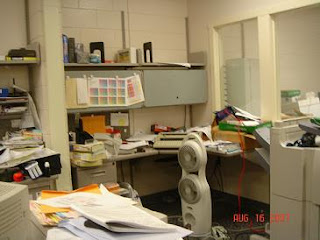 ere able to have a constant dialogue which allows us all to learn so much more. I've been thinking about a couple of opposing ideas. Think for a minute about organization... about making order out of something. When I go into my "junk" drawer where I deposit odds and ends for months (or even years), I would consider it completely disorganized. (As would most people, I would assume.) When I look for the key to the shed, or a charm that was lost from a bracelet, I might go to my junk drawer and start pawing through it, hoping to find it! I can apply the idea of organization in a different way as well. I have a ton of books. I LOVE BOOKS! I've read many of them, but there are just as many I have not read. I've given lots away and loaned many. For a long time, I had all my books in one place. At least, when I went to look for one, I knew that it "should" be with all the other books. In the last two years, I've taken the time to organize them somewhat. I have my fiction books in one place, and they are organized alphabetically by author's last name. I have my professional books in a bookcase in my office also organized by author's last name. I have my picture books in another bookcase organized by title, adolescent fiction in another place, etc. This has made finding an individual title when I want it SO much easier. Another dimension that has been affected is time; I can find my books in far less time now. I'm happier, too. Being able to locate a particular book, especially when I'm in a hurry, has reduced stress. Another benefit that I didn't expect was the ability to remember information related to the books. If I don't find the book I want, it triggers a memory that I loaned it or that I took it with me and may have left it somewhere. Do these effects of being organized (reduced time, ease in finding, less stress, memory triggers) translate to increased comprehension? I definitely think so.
I've had the opportunity to present content enhancement information to several new groups during the last few weeks. The last two days I was really fortunate in that the group was really small, so we w
 ere able to have a constant dialogue which allows us all to learn so much more. I've been thinking about a couple of opposing ideas. Think for a minute about organization... about making order out of something. When I go into my "junk" drawer where I deposit odds and ends for months (or even years), I would consider it completely disorganized. (As would most people, I would assume.) When I look for the key to the shed, or a charm that was lost from a bracelet, I might go to my junk drawer and start pawing through it, hoping to find it! I can apply the idea of organization in a different way as well. I have a ton of books. I LOVE BOOKS! I've read many of them, but there are just as many I have not read. I've given lots away and loaned many. For a long time, I had all my books in one place. At least, when I went to look for one, I knew that it "should" be with all the other books. In the last two years, I've taken the time to organize them somewhat. I have my fiction books in one place, and they are organized alphabetically by author's last name. I have my professional books in a bookcase in my office also organized by author's last name. I have my picture books in another bookcase organized by title, adolescent fiction in another place, etc. This has made finding an individual title when I want it SO much easier. Another dimension that has been affected is time; I can find my books in far less time now. I'm happier, too. Being able to locate a particular book, especially when I'm in a hurry, has reduced stress. Another benefit that I didn't expect was the ability to remember information related to the books. If I don't find the book I want, it triggers a memory that I loaned it or that I took it with me and may have left it somewhere. Do these effects of being organized (reduced time, ease in finding, less stress, memory triggers) translate to increased comprehension? I definitely think so.
However, if we look at it in reverse - comprehension preceding organization, I think there is some truth to this as well. I have to have some conceptual knowledge about my books before I can even organize them. I have to know if they are fiction or non-fiction. I have to know the broad category of where they "fit in". Think about a really common context - the grocery store... I wouldn't find potato chips in the produce aisle. So for initial understanding, I would say that very rudimentary organization must occur. We have to be able to conceptualize and categorize. However, once we get a few pieces of information, we must then organize it to be able to make broader generalizations. I'm thinking about data collection. We can have hundreds of separate bits of data - student demographics, pretest scores, post-test scores, raw scores, t-scores, and so on. It isn't until all of the data is organized in some way that we are able to make sense of it. Once we have several pieces or "bits of knowledge" we can begin to analyze, synthesize, evaluate, and make decisions about needs for further understanding. Organized information allows us to ask the right questions and focus our attentions in deeper and broader understanding.
So - let's apply this to subject matter in classrooms - especially secondary classrooms. The implication I take away is that students must have some broad conceptual knowledge base first. From there, it is through organization of information and interpretation of information that new understandings take place. Isn't that what content enhancement does? Think about any of the routines. We separate out all of the critical information first, we help students organize it by sorting through it and teaching them how to arrange it in ways that will lead to higher level comprehension and understanding of ideas.
What are your thoughts on this? Am I on the right track? I've included a couple of pictures in this entry of an office that blew my mind. I was in a school, and this was the secretary's office. She said that she could find anything in a heartbeat. I wonder, though...how does this fit with my theory?

Monday, August 18, 2008
Reflecting on My Learning
I never really understood the power of reflection before. In some ways, I think of it as similar to meditation, but a little more specific. (Does that make sense?) How does one go about reflecting? When meditating, it is important to clear the mind. When reflecting, however, I need to begin with a question. I like to ponder ideas, let them ferment, and see what comes to the surface. I attended FUSION Professional Development today with about 40 teachers and administrators. Mike Hock, Ph.D., and Irma Brasseur, Ph.D., led the professional development. Several of those in attendance are teachers that I will be directly coaching this year in their classrooms when rolling out the FUSION reading class with students this year. I found a couple of ideas particularly interesting today...
- Changing view of reading...the old view of reading, termed the simple view of reading, is defined as mastery of word recognition (fluency, decoding, & sight words), comprehension of the author's message (background information, text structure, vocabulary, & syntax), and demonstration of cognitive and metacognitive processes. Ten years ago (maybe even five years ago) students at this level would do well academically. Students who were able to do this most likely achieving at average or above average levels. THIS IS NO LONGER SO! The new view of reading is much more complex. To be successful today, students must be able to do much more than what was previously needed. Students today must be able to first comprehend the information (by doing what was stated earlier), but also merge this information with prior knowledge to create new understandings. In Levy and Murnane's book, The New Division of Labor: How Computers Are Creating the Next Job Market (2004), this is exactly what they are talking about. The new job market is going to require that applicants have expert thinking and/or complex communication skills. (By the way, this is an excellent read for ALL education professionals.)

- I love how Mike Hock talked about the reciprocal relationship between the length of the opening activity (Do Now, Sponge Activity, or whatever you want to call it) and the intensity of instruction. Think about this...and you will know it is true. The longer a teacher gives students to complete an Opening Activity, the less intense the instruction generally is. Contrast this situation with a teacher who carefully times and moves forward with the instruction after the scheduled 5 minutes for the opening. The second teacher generally understands the nature of urgency and the power of time on task. I had never heard it articulated in that way - and it really stuck with me. One is definitely a function of the other. There is a relationship between these two ideas which I find very interesting to think about. I will bet that this relationship could be extrapolated out to other settings. I need to think about this some more, but I think it has to do with discipline.
Any thoughts on reflection? Have you been finding time to reflect more? I think in this world where we are constantly trying to solve problems, that we must discipline ourselves to do this. At least I know I need to. Is this really simplistic or does it make sense to you? I'd love to hear your comments!
Saturday, August 16, 2008
Twitter - Have you heard of it?
My colleague, mentor, and friend, Jim Knight, has turned me on to a new, innovative communication tool (at least it is new to me.) I'm not quite sure what to call it - I guess the best words I can think of to describe it is an "interactive communication website." It has the capability of networking people so that we can exchange ideas and communicate with lots of people relatively quickly. Since so many people communicate with smart phones and small handheld devices, it is very convenient. Think of a bunch of birds twittering - short little communication bits that can serve to alert us to each other. I've signed up, but now I'm going to try it. I urge you to take a look at Jim Knight's blog to get a little more information. You can find his very informative posts at http://www.instructionalcoach.org/. Then sign up at the Twitter website; go to http://www.twitter.com/. Search for me using my twitter username - suewoodruff. Hope to to hear you twitter soon!
Tuesday, August 12, 2008
Counting Down to School Opening
 It is August 12 already; the time has come when most teachers (and sometimes students) begin to get anxious to return to school. Days either become the "dog days of summer" or when we are really lucky, the days become crisp and cool - almost fall-like. That is what it has been the last few days here in Michigan. There is no need for air conditioning as we have our windows open to let in the cool, clean breeze. I'm sitting in my office, periodically looking outside at the scenery, trying to NOT procrastinate. We have a beautiful view of the lake that is relaxing just to look at. We often see deer, fox, and other small animals. We also have two Great Blue Herons that live on the perimeter of the lake as well as several pair of swans. There are always Canadian geese around, too. Did you know that geese honk all night long? I guess you could say I'm procrastinating now... It all depends on how you look at it. I have been wanting to start a blog, but never had the time. So today, as I was preparing for the next few weeks of intensive professional development, I decided to give it a whirl!
I've decided to document this year's journey with a blog. I will invite other SIM professional developers to tag along. I am involved in adolescent literacy projects around the country, and I am going to share my experiences. (At least some of them.) I would like to pose questions and get advice, and I would love to hear from other SIM professional developers and instructional coaches. It is sort of an experiment. We talk about about making our teaching public; let's make our professional development public, too! I also do a lot of instructional coaching, and I love the work of Jim Knight. You may want to check out his blog as well. You can find his blog linked to the Instructionalcoach.org website. Well, I better get back to work now. I have a full week beginning next week. On Monday, Tuesday, and Wednesday of next week, I am attending FUSION Professional Development to support many teachers in my three schools involved in the Midwest CLC Research Project. If you are not familiar with FUSION, it is a newer adolescent strategic reading program developed by Mike Hock, Ph.D., and Irma Brasseur, Ph.D. at the University of Kansas Center for Research on Learning. Each of the schools in this project will have at least one teacher providing an intensive intervention for students reading 2 - 5 years below grade level. On Thursday and Friday I am having an initial professional development session with a small, rural district in Michigan. In my next post, I will share a little about FUSION and my thoughts about how we will roll this out with teachers. What are you doing to get ready for the upcoming school year? Please check back in on me periodically. OK?
Subscribe to:
Posts (Atom)